
Reviewed · LITTLE INDIA TOURS
Kampong Glam and Little India Join-in Walking Tour
Singapore’s two most rewarding cultural districts fit neatly into this 3.5-hour walking tour. You begin among the Islamic landmarks and shophouses of Kampong Glam, then continue to Little India for temples, food stalls, markets, murals, and one of the city’s most colorful streets.
I like the way the route links Sultan Mosque and Sri Veeramakaliamman Temple, two major places of worship, with ordinary streets and shopping arcades. I also like the small group limit of 15, which gives the guide room to answer questions. The main drawback is the price, $84.75, especially since admission fees, food, and anything outside the listed inclusions are extra.
Key points at a glance
- Two districts in one morning: Start in Kampong Glam and finish in Little India without spending a full day on the outing.
- Sultan Mosque anchors the first half: Learn how the mosque connects to Singapore’s early Malay and Arab communities.
- Little India is more than temples: Tekka Centre, Campbell Lane, and Little India Arcade add food, shopping, and street life.
- Guide Charles earns special praise: His clear explanations, personal answers, and practical help are major strengths.
- The route includes an MRT transfer: The walking is broken up by a ride between the two districts.
- A small group keeps things manageable: The maximum is 15 people, with a moderate fitness level required.
Why these two neighborhoods belong together
Kampong Glam and Little India show different sides of Singapore’s multicultural story. Kampong Glam grew around Malay royalty and the Muslim community. Little India developed through Indian trade, work, worship, and family life. Seeing both in one morning helps you compare the districts instead of treating them as separate photo stops.
The tour is not built around one grand attraction. Its value comes from the connections between places. A mosque leads to textile shops and Middle Eastern restaurants. A former Chinese family home appears in Little India. A market reveals what people eat and buy today. That mix gives you a better sense of how Singapore’s communities shaped one another.
The route begins at 9:00 a.m. in Bugis and ends in Little India. Starting early is useful here. The morning gives you time to look around before the day becomes hotter and busier, although Singapore’s heat and humidity still make water and comfortable shoes sensible choices.
More Little India walks:
- Chinatown, Little India, Kampong Gelam City Highlights Tour
★ 5.0 · 224 reviews - Singapore: Chinatown and Little India Guided Walking Tour
★ 4.8 · 190 reviews - Kampong Glam, Little India & Chinatown with Local Street Food Tastings
★ 4.5 · 70 reviews
Haji Lane and Arab Street: from pilgrims to indie shops
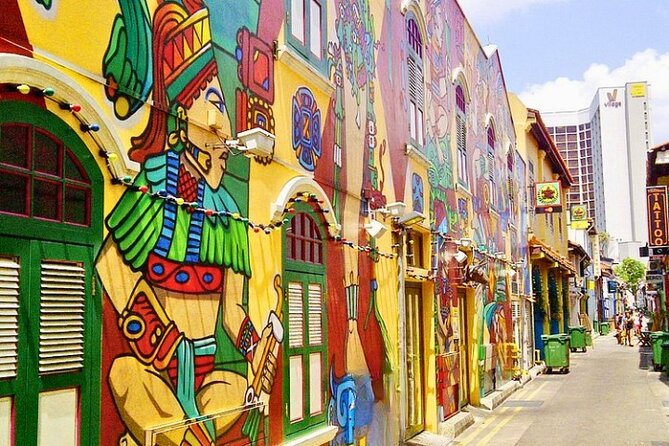
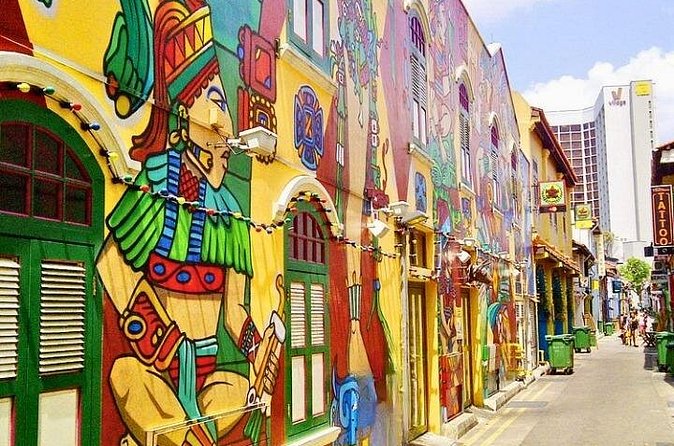
The first stop is Haji Lane, a narrow street known for painted walls, small independent boutiques, and cafés. Its earlier role was much more practical. It once provided lodging for Muslim pilgrims traveling toward Mecca. Today, its shops and street art give the lane a youthful feel, but the older purpose adds meaning to what might otherwise look like a fashionable shopping strip.
The stop is listed at about 10 minutes, so expect an introduction rather than free time for serious shopping. I would use this part of the tour to get your bearings and ask the guide how Kampong Glam changed over time.
Arab Street broadens the picture. It is tied to the district’s Islamic identity and is known for fabric shops, Middle Eastern food, and streets leading toward Sultan Mosque. Look for textiles and signs of the neighborhood’s trading past rather than treating it as just a restaurant row.
Bussorah Street, in front of Sultan Mosque, is pedestrian-friendly and lined with conserved shophouses. It is a good place to notice the contrast between old building fronts and newer cafés, restaurants, and souvenir shops. The route gives you a taste of the district without making the morning into a shopping expedition.
Sultan Mosque and the former royal quarter
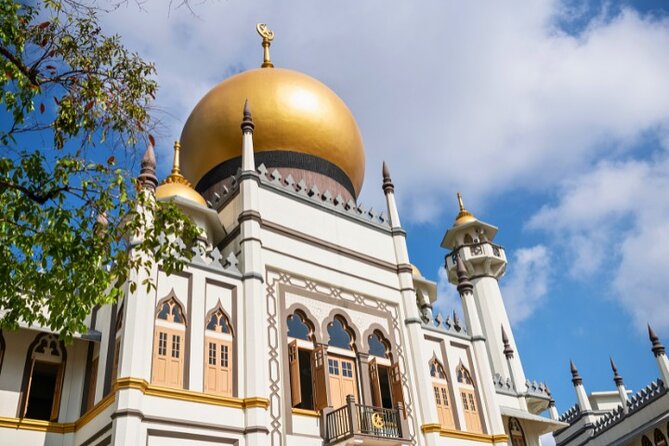
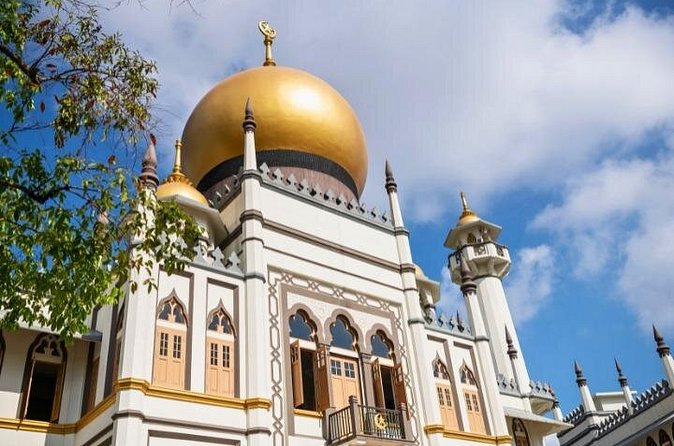
Sultan Mosque is the visual and historical center of Kampong Glam. The mosque was built in 1824 for Sultan Hussein Shah, identified as Singapore’s first sultan. Its large golden domes and broad base make it hard to miss, but the guide’s explanation is what turns the stop into more than a photograph.
The visit is scheduled for about 15 minutes, and admission is listed as free. Dress and behavior should be respectful at this active religious site. The supplied details do not promise a full interior tour, so you should expect to see the mosque and hear its story rather than count on an extended visit inside.
From there, the route touches Gedung Kuning, or Yellow Mansion. Built in the 1850s, it was associated with Malay nobility and once served as a royal residence. It now contains a restaurant and cultural space. Five minutes is enough to explain its role and point out the building, but not enough for a long visit.
Istana Kampong Glam adds another piece to the royal story. Built in the 1840s, it was home to Sultan Hussein Shah and his descendants. The former palace now houses the Malay Heritage Centre. The tour allows about five minutes here, and entry is not included. That means you should not assume the tour includes a museum visit. Instead, you receive an exterior introduction and context for the Malay royal connection.
This is one of the tour’s practical limitations. If you want to spend time inside the Malay Heritage Centre, you will need a separate visit and additional time. Still, the short stop works well in a morning route because it keeps the focus on the district as a whole.
The move to Little India
The tour then heads toward Little India. A guide-led MRT ride has been used on this route, which is a sensible way to connect the two neighborhoods. You get a small taste of Singapore’s efficient public transport while avoiding a long walk between districts.
The exact transport arrangements should be confirmed at the start, since the listed meeting point is Bugis and the tour description presents the experience as a walking tour. In practical terms, expect walking in both neighborhoods with an MRT transfer between them, not one continuous walk from Kampong Glam to Little India.
Race Course Road helps introduce Little India’s past. Its name comes from the Serangoon Road Race Course, Singapore’s first horse racing track, established in 1842 in what is now Farrer Park. The road is now part of a very different setting, with Indian shops, food, and community life around it.
This kind of detail is easy to miss when exploring alone. A street name can look ordinary until you know what once occupied the area. The guide’s job here is to connect the modern district with earlier uses of the land.
More Kampong Glam and Arab Street walks:
- #instawalk: Bugis, Waterloo, Kampong Glam
★ 5.0 · 60 reviews - Tasting Trails: Chinatown OR with Kampong Glam, Little India
★ 5.0 · 59 reviews - 5 hours Little India, Kampong Glam, Chinatown with 9 Food Tasting
★ 5.0 · 58 reviews - Singapore: Kampong Glam & Civic District Vespa Sidecar Ride
★ 4.9 · 49 reviews
Tekka Centre: food, shopping, and everyday Singapore
Tekka Centre is one of the most useful stops for understanding Little India as a living neighborhood. The complex combines a wet market, hawker centre, and shops. It began in 1915 and was rebuilt at its current site in 1982 before later changes.
The tour allows about 15 minutes. That is enough to walk through and take in the smells, colors, and activity, but probably not enough for a leisurely meal. Food and purchases are not included, so bring money if you want to sample something, though the short schedule may make eating on the spot difficult.
I like this stop because it balances the grander landmarks. Temples and heritage buildings tell you about identity and memory. A market shows how that identity appears in daily life, through ingredients, prepared food, flowers, and shopping habits.
Do not expect a guided food tour. The information provided promises a visit to the center, not tastings or a meal. If Tekka Centre interests you, you may want to return after the tour with more time.
Tan Teng Niah’s colorful house
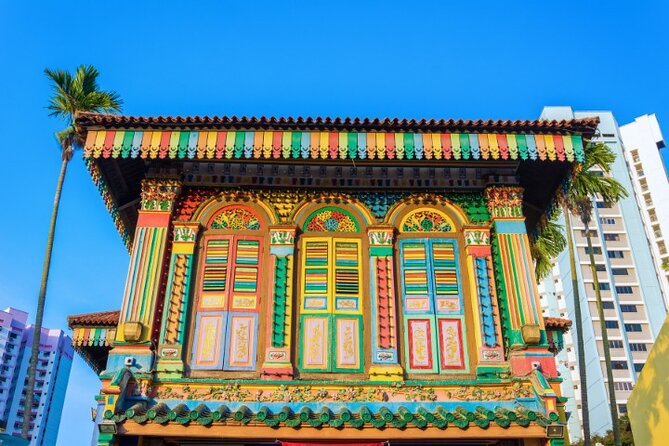
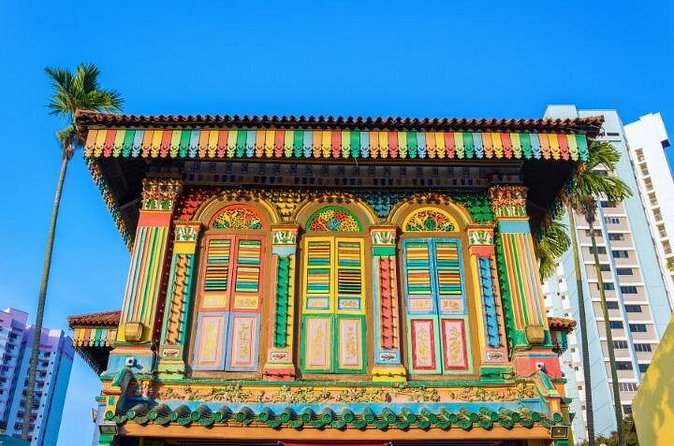
The Former House of Tan Teng Niah is one of Little India’s most photogenic buildings. It was built in 1900 by Tan Teng Niah, a Chinese confectionery businessman, and is unusual because it survives in the heart of a district associated strongly with Indian culture.
The house is the last surviving Chinese villa in Little India, according to the tour information. Its bright paintwork makes it an easy landmark to spot, but the more useful lesson is its presence in a mixed commercial and residential area. Singapore’s ethnic districts were never sealed boxes. Communities lived, worked, traded, and built close to one another.
The stop lasts about five minutes, so plan on a short explanation and photographs. Admission is not included. The tour does not promise access to the house, so treat it as an exterior sight.
Sri Veeramakaliamman Temple
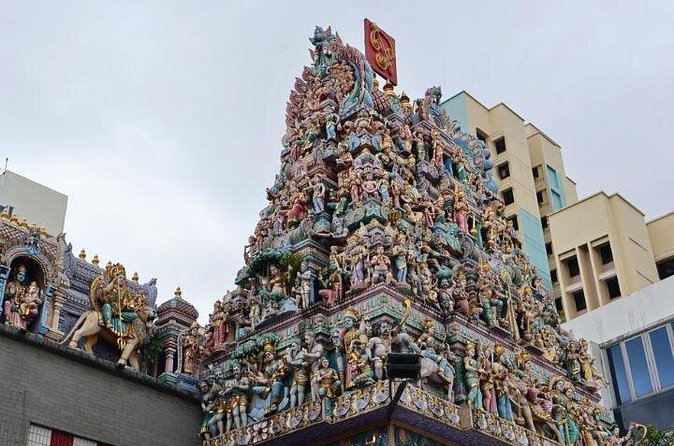
Sri Veeramakaliamman Temple is one of the oldest Hindu temples in Singapore. It began as a shrine in 1855 and was rebuilt in 1881 by Indian pioneers on Serangoon Road. The temple is dedicated to Kali, a powerful Hindu goddess.
The scheduled visit is about 15 minutes, and admission is listed as free. This is a place to slow down, observe respectfully, and listen to the guide’s explanation of the temple’s role. Religious sites are not stage sets, so photography, clothing, and behavior should be handled with care.
The temple gives the Little India portion a strong focal point, much as Sultan Mosque does in Kampong Glam. Together, the two sites help you understand how worship shaped each neighborhood. The comparison is one of the best reasons to choose this tour instead of visiting only one district.
The timing remains a consideration. Fifteen minutes can introduce the site, but it is not a long temple visit. If you want a detailed look at architecture, rituals, or the surrounding shops, leave room to return independently.
Little India Arcade and Campbell Lane
Little India Arcade occupies conserved neoclassical shophouses built in 1913. The shopping complex officially opened in 1995 and was developed by the Hindu Endowments Board. Inside, you may find traditional Indian clothing, souvenirs, sweets, and other goods associated with the district.
The tour allows about 10 minutes, with admission not included. The arcade is best treated as a quick orientation stop. You can see how old commercial buildings have been adapted for modern retail, but serious browsing will need extra time after the tour.
Campbell Lane provides the final street-level note. It is a pedestrian street known for Indian shops, food, and cultural activity. Its earlier connection to livestock trading gives the lane another reminder that Singapore’s neighborhoods change while old names and routes remain.
Ending in Little India is useful. You are left near shops, food, and transport rather than being returned to the starting point. It also means you can extend the morning on your own if you want more time at Tekka Centre, the temple, or Little India Arcade.
What the guide adds to the price
At $84.75 per person, this is not a bargain-priced orientation walk. You are paying for a licensed English-speaking guide, a planned route, interpretation at several heritage sites, and a small group capped at 15. You are not paying for meals, museum admissions, or shopping.
The guide matters greatly here because many stops are brief. A building such as Gedung Kuning or the former House of Tan Teng Niah can be reduced to a quick photograph without context. A good explanation gives each place a reason to matter.
Charles is the guide named most warmly in the tour feedback. He is praised for clear explanations, personal answers, and helpful advice beyond the formal route. One particularly useful strength is his ability to adjust the experience to the people in front of him. The route has been described as well paced, with an MRT ride linking the two communities.
That kind of personal attention can justify the cost for a first visit to Singapore, especially if you prefer an organized introduction. It is harder to justify if you already know both neighborhoods, want extensive shopping time, or are comfortable researching the sites yourself.
Pace, group size, and what to bring
Three and a half hours is enough to sample both districts, not enough to explore every shop or attraction. You will move between stops, stand during explanations, and walk on city streets. A moderate level of fitness is required.
The maximum group size is 15. That is small enough for questions to be practical, though the experience may feel different with a full group than with only a few people. The mobile ticket is convenient, and confirmation is provided at booking.
Wear comfortable shoes and bring water. The tour starts at 9:00 a.m., which helps, but Singapore’s climate can still make walking tiring. Since the outing ends in Little India, plan your next activity from there rather than assuming you will return to Bugis.
Free cancellation is available if you cancel at least 24 hours before the start time. Cancellations or changes made later are not refunded or accepted, with cut-off times based on Singapore’s local time.
Who should book this walking tour?
I would recommend it to first-time visitors who want a clear introduction to Singapore’s Malay, Arab, and Indian communities without spending a full day in a museum. It also suits you if you prefer stories and local context to simply collecting landmark photographs.
The tour is a good fit for anyone who wants a guide to explain why Haji Lane, Sultan Mosque, Tekka Centre, and Sri Veeramakaliamman Temple matter. It is also useful if you want to learn the MRT route between Bugis and Little India while keeping the morning organized.
I would think twice if your main goal is shopping, eating, or detailed worship-site visits. The schedule gives you short stops, and some buildings are seen from outside. The $84.75 cost also becomes harder to defend if you do not value guided explanation.
Should you book the Kampong Glam and Little India tour?
Book it if you want two distinct cultural districts explained in one well-planned morning. The strongest reasons are the balanced route, the small group limit, the contrast between Sultan Mosque and Sri Veeramakaliamman Temple, and the possibility of a particularly helpful guide such as Charles.
Skip it if you prefer to set your own pace or want long meals and shopping sessions. For most first-time visitors, though, the tour offers a useful framework. You can return later to the places that deserve more time, now knowing what you are looking at and why it matters.
FAQ
Where does the tour start?
The tour starts in Bugis, Singapore, at 9:00 a.m.
Where does the tour finish?
The tour ends in Little India, Singapore.
How long does the experience last?
The walking tour lasts approximately 3 hours and 30 minutes.
What is included in the tour?
The price includes the 3.5-hour walking tour and an English-speaking licensed tourist guide.
Are admission fees included?
No. Admission or entry fees are not included. The listed stops at Sultan Mosque, Tekka Centre, and Sri Veeramakaliamman Temple have free admission, while entry is not included for Gedung Kuning, Istana Kampong Glam, the Former House of Tan Teng Niah, and Little India Arcade.
How many people can join the tour?
The tour has a maximum of 15 participants. A moderate level of physical fitness is required, and the experience is near public transportation.
More Walking Tours in Singapore
- Singapore: Private Walking Tour with a Local
★ 4.7 · 410 reviews - Private Customised Singapore Walking Tour
★ 5.0 · 370 reviews - Singapore: Customized Private Tours (Car/Bus/Walking)
★ 5.0 · 181 reviews - Eat Snap Katong Walking Food Tour
★ 5.0 · 174 reviews
Recently added around Singapore
- The Real Singapore Heartland Walking Food Tour★ 5.0 · 4 reviews
- Vegetarian Culinary Adventure in Singapore★ 5.0 · 7 reviews
- Singapore’s Marina Bay Wonders and Heritage Tales, Chinatown★ 5.0 · 5 reviews
- Private Tour Singapore Street Food & Night Tour★ 5.0 · 4 reviews
- Singapore’s Hidden Treasures: A Cultural Private Tour★ 5.0 · 3 reviews
- Singapore – Albatross Speedboat Adventures Cruising in Sentosa★ 5.0 · 3 reviews
- Small Group Full Day Singapore City Tour with Roundtrip Transfers★ 4.0 · 11 reviews
- Tastes of Chinatown★ 5.0 · 4 reviews
Little India Tours, compared.
Chinatown, Little India, Kampong Gelam City Highlights Tour
Read our review →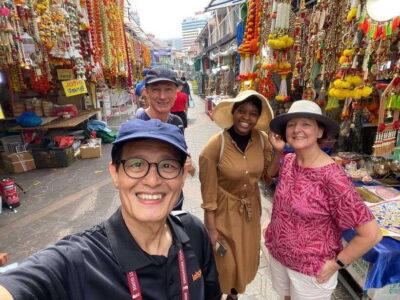
Singapore: Chinatown and Little India Guided Walking Tour
Read our review →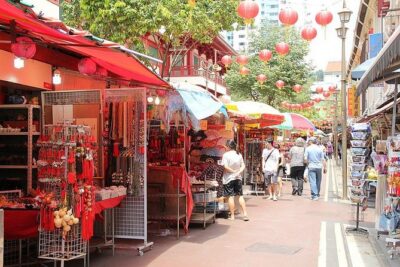
Kampong Glam, Little India & Chinatown with Local Street Food Tastings
Read our review →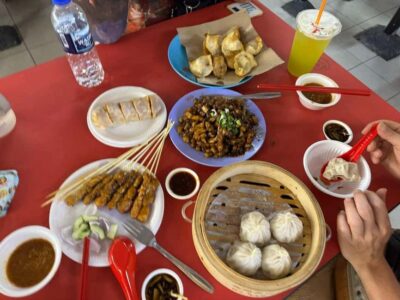
Tasting Trails: Chinatown OR with Kampong Glam, Little India
Read our review →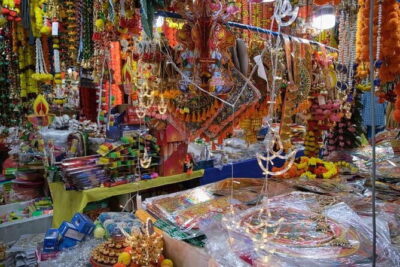
5 hours Little India, Kampong Glam, Chinatown with 9 Food Tasting
Read our review →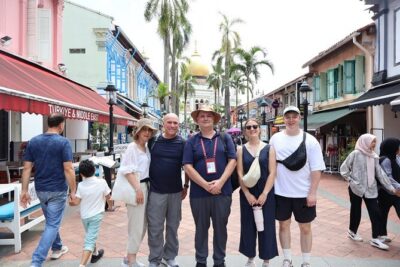
4-hour Chinatown, Little India, and Arab Street Walking Tour
Read our review →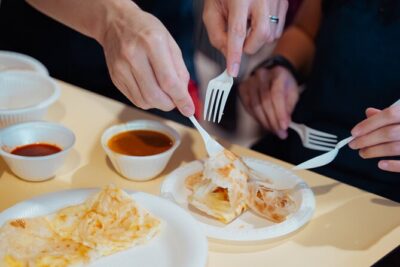
Private Singapore Food Tour in Chinatown and Little India
Read our review →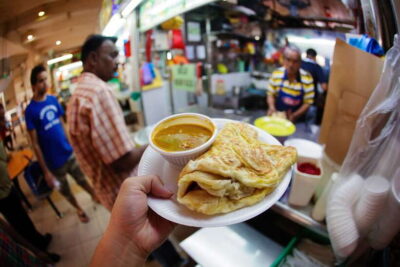
Browse the lists this tour appears in